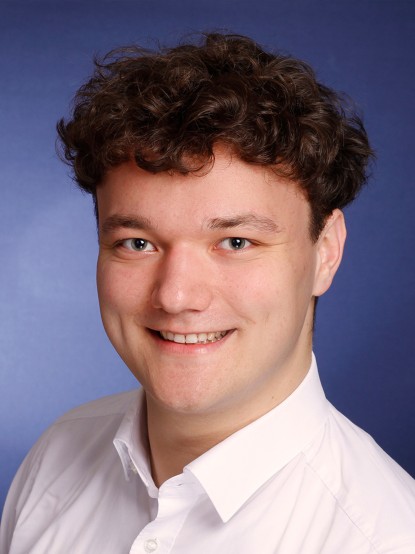
Maximilian Nolte M.Sc.
Working area(s)
Sustainable Software Engineering of Research Software for the Isogeometric Boundary Element Method
Contact
maximilian.nolte@tu-...
work +49 6151 16-24386
Work
S2|17 37
Schloßgartenstr. 8
64289
Darmstadt
Computational Electromagnetics (CEM)
Sustainable Software Engineering of Research Software for the Isogeometric Boundary Element Method
maximilian.nolte@tu-...
work +49 6151 16-24386
Work
S2|17 37
Schloßgartenstr. 8
64289
Darmstadt

My research focuses on the mathematical modeling, analysis and simulation of magnetoelastic coupling phenomena, which occur in so-called “magnetostrictive” materials. The main emphasis is on the derivation, analysis and solution of systems of coupled PDEs including the equations of elasticity and Maxwell's equations. Magnetostrictive materials have wide application areas: they are often used as sensors or actuators in mechanical systems or as artificial muscles in robotics. Our current eld of research in which multiphysics is relevant (coupling of electromagnetic, thermal and mechanical fields) is the development of high-temperature superconducting magnets for particle accelerators. Unlike conventional magnets, the high-current coils of superconducting magnets are exposed to massive Lorentz forces, which can lead to significant deformations within the structures. These deformations, on the other hand, can change the structure of the magnets and have a negative effect on the quality of the magnetic eld as well as the homogeneity of the temperature eld. From the modeling point of view, a coupled multi- eld problem arises, whose mathematical formalization, analysis and solution is essential for the study of the functionality, robustness and lifetime of the construction.
sebastian.schoeps@tu-...
work +49 6151 16-24409
fax +49 6151 16-24027
Work
S2|17 29
Schloßgartenstr. 8
64289
Darmstadt
We would like to customise the information and usability of this website to your preferences and needs.
To this end, we use so-called cookies. Please choose which cookies you would like to enable when visiting our webpages.
Some of these cookies are required to load and correctly display this website on your device.
These are strictly necessary or essential cookies and cannot be deselected.
The preferences cookie saves your language setting, while the statistics cookie regulates
how the open-source statistical software “Matomo” analyses your visits to and activities on our website.
For more information about cookies we use, please refer to our
privacy policy.